Puzzle Guides
How Accounting Firms Balance the Books with AI | Sept 2026
This practical guide provides a step-by-step blueprint for accounting firms ready to move beyond analysis paralysis and embrace AI as a strategic advantage.

5.1.25
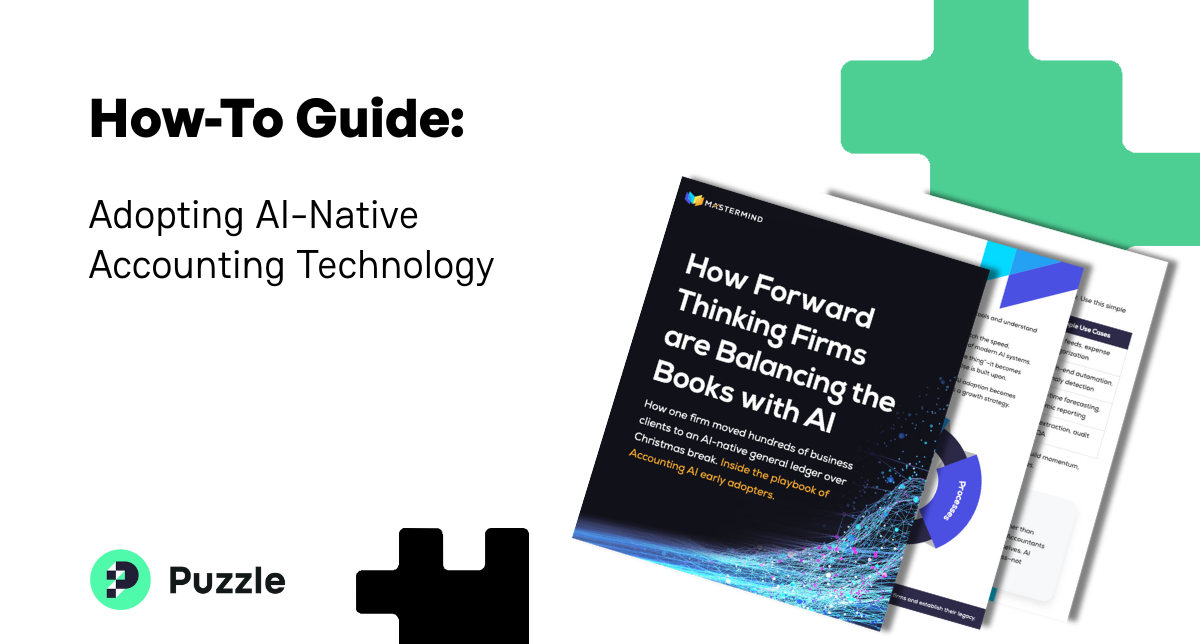
This practical guide provides a step-by-step blueprint for accounting firms ready to move beyond analysis paralysis and embrace AI as a strategic advantage.
Are You Being Left Behind in the Accounting AI Revolution?
Accounting firms today face a perfect storm: 75% of CPAs approaching retirement age, increasing client demands for real-time insights, and the pressure to do more with fewer resources. Meanwhile, AI capabilities have matured significantly—yet many firms remain paralyzed by uncertainty about how to implement this technology effectively.
Our new whitepaper, "How Forward-Thinking Firms are Balancing the Books with AI," offers a blueprint for accounting firms ready to move beyond analysis paralysis and adopt AI as a strategic advantage.
TLDR:
This practical guide provides a step-by-step framework for assessing and adopting AI-native accounting platforms, featuring insights from industry leaders:
We saw too many accounting firms struggling with the same challenges. As the whitepaper states: "The challenge is no longer access to the technology—it's having the framework and leadership to adopt it effectively."
| Topic | Challenge it solves | Outcome |
|---|---|---|
| Month-end close speed | Close processes traditionally take 5–15 days | AI-native tools deliver accurate books in a fraction of the time |
| Scaling without headcount | Growing client load requires proportional staff increases | Real-time, accurate financials delivered without hiring more |
| Overcoming perfection culture | Accountants are used to being right the first time | Workflows with review checkpoints build confidence in AI output |
| Role transformation | Staff stuck in data-processing mode | Bookkeepers become analysts; accountants become advisors |
| Assessing AI-native tools | Hard to distinguish true AI-native from bolt-ons to legacy systems | Framework to identify architecture built from the ground up for AI |
| Adoption roadmap | Unclear where to start with AI implementation | Identify right entry points to prove ROI and build internal trust |
The most successful firms won't just be using AI: their entire practice will be reshaped by it. As Sasha Orloff puts it in the paper: "You're not going to get replaced by AI—but you will be replaced by someone who uses AI."
The whitepaper's urgency has only sharpened since it was written. Karbon's 2026 State of AI in Accounting Report — drawn from nearly 600 accounting professionals across six continents — found that 98% of firms now use AI, with the majority using it daily. Organizational AI adoption in finance has nearly doubled in a single year, jumping from 22% to 40% between the 2025 and 2026 Thomson Reuters surveys.
The cost of waiting is getting quantifiable. Thomson Reuters research released this past June warns of $143 billion in U.S. revenue at risk for firms that fall behind on AI implementation — as clients increasingly expect AI-driven value and top talent gravitates toward firms that deliver it. Meanwhile, KPMG's 2026 AI in Finance report found that 93% of U.S. companies expect to deploy or scale AI within their finance functions over the next 18 months. The window for a measured, strategic adoption — the kind this whitepaper outlines — is open now, but not indefinitely.
Download the whitepaper now to position your firm at the forefront of accounting's AI revolution.
AI-native platforms eliminate the bulk of manual data entry by connecting directly to a firm's existing fintech stack (bank feeds, payment processors, payroll providers) and categorizing transactions automatically as they arrive. Instead of a bookkeeper reviewing and coding each line item, the AI applies learned rules and context to categorize the vast majority of transactions without human intervention. Staff time moves from data entry to exception review: flagging the small percentage of transactions the model isn't confident about, then approving or correcting them. The result is that work that traditionally consumed hours per client per month is compressed to minutes. The whitepaper covers this move in depth, with Puzzle's Sasha Orloff explaining how AI-native tools can close books "in a fraction of the time" compared to legacy workflows built around manual entry.
The firms scaling most efficiently right now are standardizing their workflows around AI-native tools that handle the repetitive, high-volume work (transaction categorization, reconciliation, month-end checklists) so each bookkeeper can support a larger client load without burning out. The Decimal case study in the whitepaper is a concrete example: by adopting AI-native platforms, the firm scaled its client base without a proportional increase in headcount, delivering real-time, accurate financials at a pace that legacy staffing models can't match. Before committing to a platform, it's worth checking AI readiness for accounting firms: the key levers are workflow standardization (every client engagement runs off the same repeatable process) and automation of tasks that don't require human judgment, freeing your team to focus on advisory work that actually requires their expertise.
The platforms purpose-built for this are AI-native accounting tools: software designed from the ground up to automate data ingestion, categorization, and reconciliation across every client simultaneously, not legacy platforms retrofitted with AI add-ons. The distinction matters: bolt-on AI still requires a human to work through the same manual steps; AI-native architecture changes the underlying workflow. For a firm at 50+ clients, the practical criteria are: Does it auto-categorize transactions across all client books with a single review queue? Can staff manage exceptions in bulk instead of client-by-client? Does it surface real-time financials without manual exports? The whitepaper outlines a framework for determining whether a platform is truly AI-native or just AI-marketed.
The shift from monthly PDF reports to real-time dashboards happens when a firm's books are always current, updated continuously throughout the month rather than in a single batch at close. AI-native platforms that categorize and balance transactions automatically, in real time instead of a manual batch at close, mean the underlying data is accurate daily. That live data can feed AI real-time dashboards showing burn rate, runway, cash flow, and P&L in real time, instead of a static snapshot that's already 30 days stale by the time the client reads it. As the whitepaper notes, this repositions the accountant from report producer to strategic advisor: clients stop waiting for the monthly PDF and start making decisions from live visibility into their numbers.
This is one of the most important questions firms should ask before adopting any AI tool. The answer depends entirely on the platform's data architecture. AI-native accounting platforms purpose-built for financial data process client information within a controlled, private environment: client financials never leave the platform to train a public model or get pooled across users. The risk with general-purpose AI tools like the free tiers of ChatGPT is that data submitted through those interfaces may be used to improve the underlying model. Firms assessing AI tools should ask vendors directly: Is client data used to train the model? Is data isolated per firm, or pooled? What certifications (SOC 2, etc.) govern data handling? The whitepaper's evaluation framework covers this as part of assessing whether a platform is truly built for professional accounting use, and not merely a consumer AI tool applied to spreadsheets.
AI-native categorization improves through a feedback loop built into normal review work. When a bookkeeper corrects or overrides a categorization, the platform learns from that correction and applies it to similar transactions going forward, effectively converting one-off fixes into persistent rules. The strongest platforms also apply learned patterns across the account from the moment of onboarding, so the model isn't starting from zero on day one. In practice: the first month may require more exception review; by month three or four, the volume of corrections drops substantially as the AI absorbs the firm's coding preferences, chart of accounts structure, and client-specific patterns. The whitepaper's framework for assessing AI-native tools includes asking vendors how categorization rules are created, whether they're firm-specific or pooled across customers, and how correction history is preserved when staff turns over.
Accounting firm partners go through a different onboarding track than direct business customers. Firms get access to a dedicated partner program with structured onboarding designed around multi-client workflows: how to set up client workspaces, manage permissions across the book, and train staff on the review queue instead of individual client books one at a time. Support for firm partners is given priority because a single firm contact represents multiple client relationships; issues that affect one firm workflow can affect dozens of clients. Direct business customers onboard as individual accounts. If you're reviewing Puzzle on behalf of a firm, it's worth asking the sales team about the partner program structure, the dedicated support tier, and what implementation resources are included, rather than forming a view based on the self-serve, single-business onboarding flow.
The right migration path depends on how far through the cleanup you are and what you actually need from history. The three options (importing cleaned data, pulling raw transactions, or starting fresh) each have different trade-offs. Importing cleaned data is the cleanest cut: you migrate books in their final, corrected state and the new platform opens with accurate historical financials. Pulling raw transactions preserves the full audit trail but also imports the errors, which means you're doing cleanup work inside the new system instead of the old one. Starting fresh (carrying over opening balances only) avoids the migration complexity entirely but loses transaction-level history inside the platform. For most firms mid-cleanup, the practical answer is to finish the cleanup in QuickBooks first, even just getting to a closed, balanced period, then migrate to one of the best AI-native QuickBooks alternatives. Bringing unresolved books into a new system usually compounds the problem instead of solving it. The whitepaper's adoption framework covers this as part of identifying the right entry points for AI: getting clean data flowing into an AI-native platform is a prerequisite for the automation to work accurately.
The AI Close agent runs the month-end close checklist automatically, pulling together the reconciliation steps, flagging open items, and working through the close sequence without a bookkeeper manually driving each step. Available agents and templates cover the standard monthly close workflow: bank reconciliation, categorization review, accruals reminders, and close confirmation. AI credits are consumed per close run, with the credit cost scaling based on the complexity of the engagement (transaction volume, number of accounts, integrations active). Firms on higher-tier plans typically get a monthly credit allocation sized for their client volume; additional credits can be added if a month runs heavy. The practical implication for firm partners weighing cost: map your average monthly transaction volume and number of active integrations per client to get a realistic credit consumption estimate before committing to a plan tier. The whitepaper's section on AI-native architecture covers why agentic AI month-end close workflows (where AI executes the steps but a human approves before anything finalizes) represent a fundamentally different model than bolt-on automation layered onto legacy close processes.