Product Updates
Accounting Software That Catches Mistakes Before You Do – Aug 2026
Puzzle's AI Accuracy Review catches transaction inconsistencies and month-end errors before they become costly problems. Real-time flagging + bulk fixes.

9.10.25
Puzzle's AI Accuracy Review catches transaction inconsistencies and month-end errors before they become costly problems. Real-time flagging + bulk fixes.
"We co-developed this AI accuracy review with Puzzle, showing our commitment to delivering the highest bar of accuracy for our clients. Matt Tait, CEO, Decimal
Here's a scenario every bookkeeper knows too well: You're doing the month-end close for March and notice something odd. IT expenses are scattered across three different categories—some in Software COGS, others in Operating Expenses, and a few in R&D. Same vendor, same types of transactions, but completely inconsistent categorization.
Now multiply this across dozens of vendors, hundreds of transactions, and multiple clients. What should take hours turns into days of detective work, hunting down inconsistencies that could have been caught months ago.
This is the problem with legacy accounting systems: they weren't built to guarantee accuracy, only to delegate it.
TLDR:
- Manual bookkeeping carries a 1-3% transaction error rate, with misclassifications as the top cause
- A Stanford and MIT study found AI adoption cut monthly close time by 7.5 days, but created a new risk: confident misclassifications that go unchallenged without human review
- Legacy accounting software gets you to 95-98% accuracy; the remaining 2-5% is where financial statements go wrong
- Puzzle's Accuracy Review runs continuously on 100% of transactions, flagging vendor and description mismatches in real time before month-end
- Puzzle's Accuracy Review was co-developed with Decimal and partners with accounting firms instead of competing against them
When transaction categorization is inconsistent, the problems compound quickly:
The current solution? Manual review, spot-checking, and hoping your memory (or notes) catch everything. It's not scalable, and it's not reliable.
Puzzle's new Accuracy Review flips this model entirely, working at two levels to catch problems before they become costly errors.
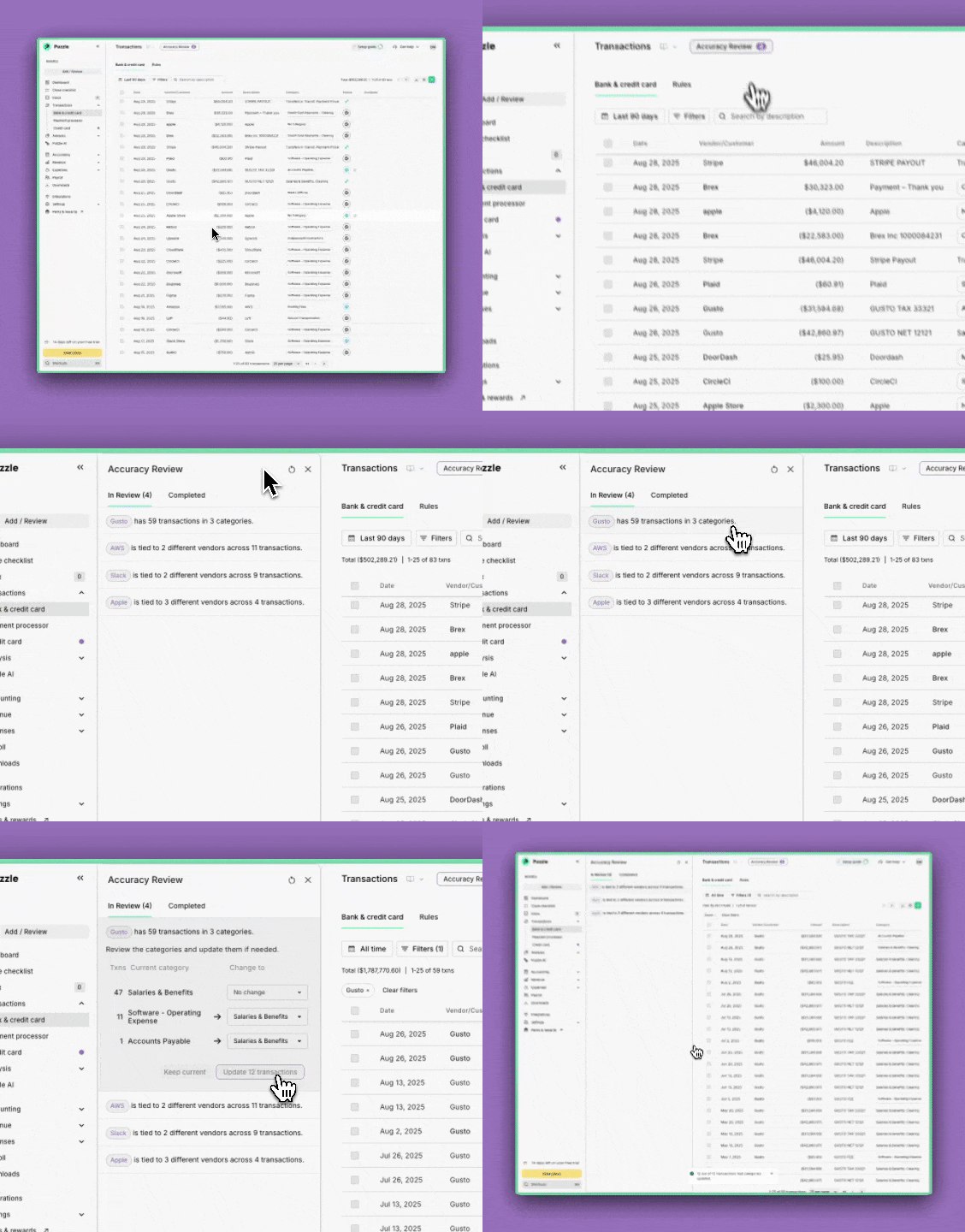
Our automated consistency engine continuously reviews 100% of your transactions and flags inconsistencies as they happen:
Vendor/Category Consistency Check: Flags when the same vendor appears across multiple expense categories. Consider when a vendor is applied to 4 different categories.
Description/Vendor Consistency Check: Identifies when identical transaction descriptions are assigned to different vendors (like "Accounting Fees" being tied to both "Burkland" and "Burkland Associates")
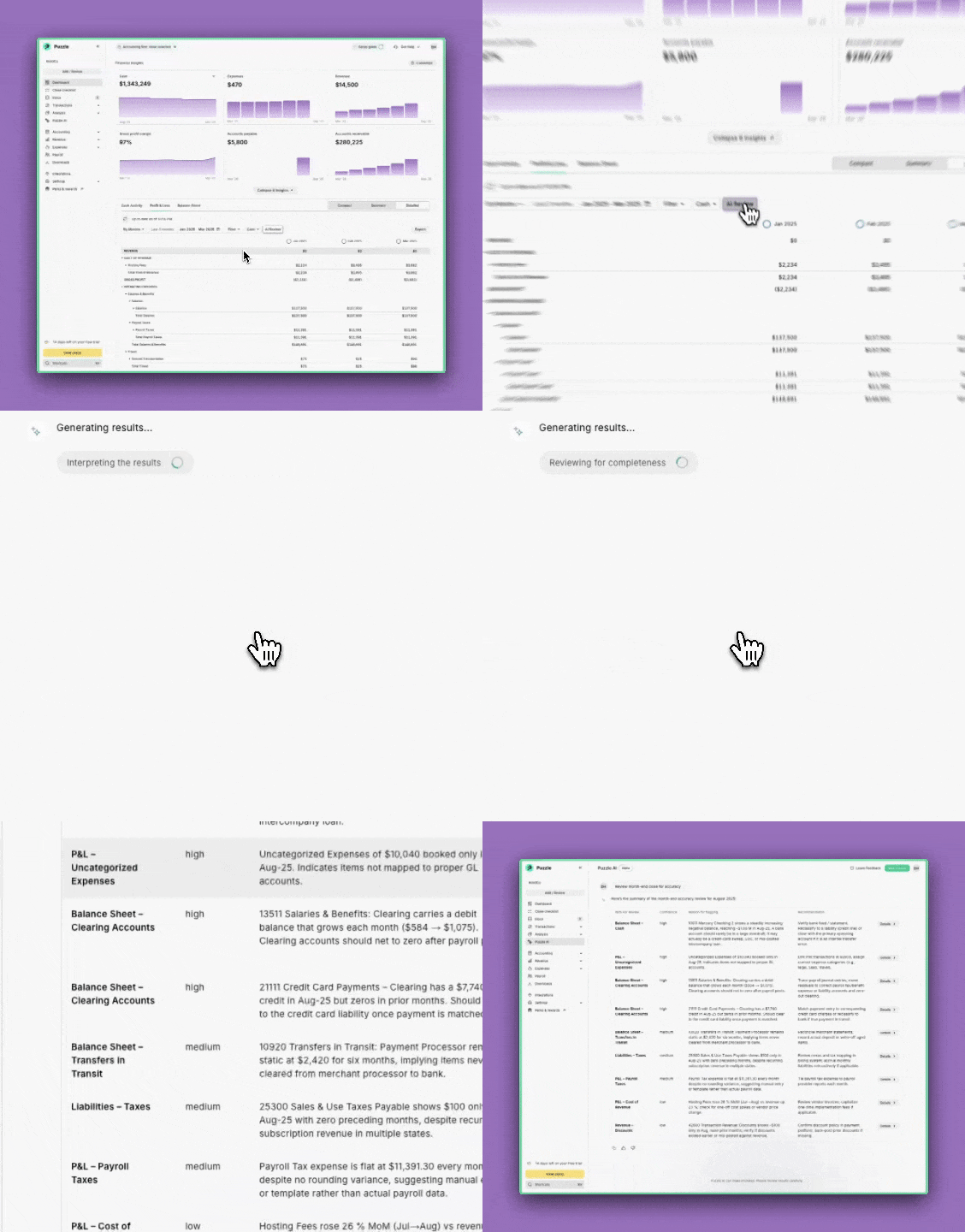
At month-end, you can run a full AI review of your entire financial statement. Puzzle AI analyzes your books across all major accounting areas and provides specific, actionable recommendations.
The AI catches a wide range of potential issues, for example:
Each flagged issue comes with a confidence level and specific next steps. Best of all, you can click directly on any concern to jump to the source data for immediate review: no more hunting through spreadsheets or multiple screens to understand what needs attention.
The result? Instead of hunting for inconsistencies during month-end crunch time, you get clean transaction data year-round, plus a thorough month-end checklist that keeps anything from falling through the cracks.
We didn't build this feature in isolation. We co-developed it with leading accounting firms like Decimal, who manage hundreds of client accounts: the kind of firms where month-end close software for multiple clients needs to work flawlessly and know exactly where consistency breaks down.
The difference shows in the details:
Time savings are immediate. What used to take hours of manual review now happens automatically, with results you can action in minutes.
Unlike other players in the market, Puzzle doesn't offer accounting services because we partner with firms, not compete against them. When firms like Decimal trust us with hundreds of their client accounts, that partnership drives product development that actually solves real problems.
We're building tools that help accountants deliver higher-value work to their clients, not trying to replace them.
The timing of Accuracy Review isn't accidental. A Stanford and MIT study published this year (one of the first large empirical analyses of generative AI in accounting) found that while AI adoption cut monthly close time by 7.5 days and shifted 8.5% of accountant time away from routine data entry, it also surfaced a critical risk: accountants sometimes over-relied on inaccurate AI-generated classifications. The takeaway wasn't that AI is dangerous. It was that AI without human-in-the-loop review creates a new category of error: confident misclassifications that slip through unchallenged.
Industry data reinforces the stakes. Manual bookkeeping carries a 1–3% transaction error rate, with misclassifications being the most common culprit. As covered in catching accounting errors before clients do, the accountant is almost always the one who finds them first. And according to Thomson Reuters' 2026 tax industry trends research, accuracy has risen to the top concern firms cite when assessing AI tools, above speed, above cost. Firms that treat AI adoption and AI accuracy as two sides of the same decision are the ones pulling ahead.
That's exactly the gap Accuracy Review is designed to close: automation you can actually verify.
Modern accounting software categorizes transactions using a combination of rules-based matching and machine learning, but most legacy systems stop there, leaving accuracy verification entirely to the human reviewing the books. Here's how the layers work:
Rules-based matching handles the straightforward cases: a transaction from Gusto maps to Payroll Expense because you told the system to make that mapping. It's fast and deterministic, but it breaks the moment a vendor name changes slightly or the same vendor legitimately spans multiple categories.
Machine learning pattern recognition goes further by learning from historical categorizations across your books. It uses transaction descriptions, amounts, merchant codes, and timing signals to predict the right category for new transactions, without requiring a manual rule for every permutation.
| Layer | How it works | Where it breaks down | Who handles it |
|---|---|---|---|
| Rules-based matching | Maps known vendors to preset categories (e.g., Gusto → Payroll Expense) | Breaks when vendor names change slightly or a vendor spans multiple categories | You configure the rules |
| ML pattern recognition | Learns from historical categorizations using descriptions, amounts, merchant codes & timing | Covers ~95–98% of transactions; the remaining 2–5% and silent inconsistencies slip through | Automated by the system |
| Puzzle Accuracy Review | Runs continuously on top of categorized transactions; flags vendor/category and description/vendor mismatches in real time | N/A: this is the audit layer that catches what the layers above miss | AI-flagged; you resolve |
Where most systems stop is where Puzzle's Accuracy Review starts. Automated categorization gets you to roughly 95–98% of transactions correctly bucketed. The remaining 2–5% (along with the silent inconsistencies in the 98%) are where financial statements go wrong. Puzzle's consistency engine runs continuously on top of categorized transactions, flagging cases where the same vendor lands in multiple categories, or where identical descriptions are assigned to different vendors. It's not replacing the categorization layer; it's auditing it in real time, so errors surface when they're easy to fix, not during month-end crunch.
At month-end, you open Puzzle AI and run the AI Statement Accuracy Review across your client's financial statements. The AI scans all major accounting areas (A/R, expense classification, bank reconciliation, equity roll-forward, and data integrity) and returns a ranked checklist of flagged issues, each with a confidence level and a direct link to the source data. You click into any concern, review the underlying transaction, and resolve it on the spot. The result is a structured, repeatable close process, not an open-ended hunt for errors. Throughout the month, the real-time Transaction Accuracy Review runs continuously in the background, so by the time you reach month-end, the majority of categorization inconsistencies are already resolved.
Three things matter most at scale: accuracy verification (automation plus auditability), multi-client architecture, and a partner model. Automation without verification creates a new risk: confident misclassifications that slip through unchallenged. Look for a platform that audits its own AI output in real time, the way Puzzle's consistency engine flags vendor and description mismatches before they compound. Multi-client architecture matters because firm-wide adoption means managing hundreds of books simultaneously; the platform needs to maintain client-specific categorization logic without cross-contamination. And the partner model matters: Puzzle doesn't offer competing accounting services, so every product decision, including Accuracy Review co-developed with Decimal, is built to make your firm more valuable, not to displace it.
The real shift is moving from reactive error-hunting to proactive flagging. Today, inconsistencies surface during month-end review, which means a bookkeeper spends hours re-tracing transactions that were miscategorized weeks earlier. Accuracy Review catches those mismatches the moment they occur, so the backlog never builds. Bulk actions let you resolve multiple flagged transactions at once instead of editing them one by one. And the AI Statement Accuracy Review at month-end replaces the open-ended "what did I miss?" pass with a structured checklist. Together, those changes compress per-client close time by a meaningful margin, which means your team can absorb more clients with the same headcount instead of hiring proportionally to grow.
Yes. You can turn on Accuracy Review for a single client account in Puzzle without affecting the rest of your portfolio. During the evaluation period, Puzzle can run in parallel with an existing system; your team continues working in QuickBooks or Sage while testing Accuracy Review on the same client's data in Puzzle. That parallel run gives you a direct, apples-to-apples comparison: the issues Puzzle flags versus what your current workflow catches. Once you're confident in the results, rolling out to additional clients is incremental. Reach out to the Puzzle team to set up a structured pilot for a complex client; that's typically where the time savings are most visible, and where the accuracy signal is strongest.
Transaction Accuracy Review is available now to all customers on our Complete plan and above.
AI Statement Accuracy Review is currently in alpha. You can access it through Puzzle AI at month-end to run a full accuracy analysis across your financial statements.
The goal isn't to eliminate human judgment—it's to give you the tools to apply that judgment more effectively and quickly. Your expertise in understanding client needs and business context remains irreplaceable. But now you can spend more time on that high-value work and less time on hunting down inconsistencies and potential errors.
Because accurate books shouldn't depend on perfect memory. They should depend on systems that actually help you get there.
---
Ready to see how Accuracy Review works with your data? Log into Puzzle and check out the new Accuracy Review drawer in your Transaction page.